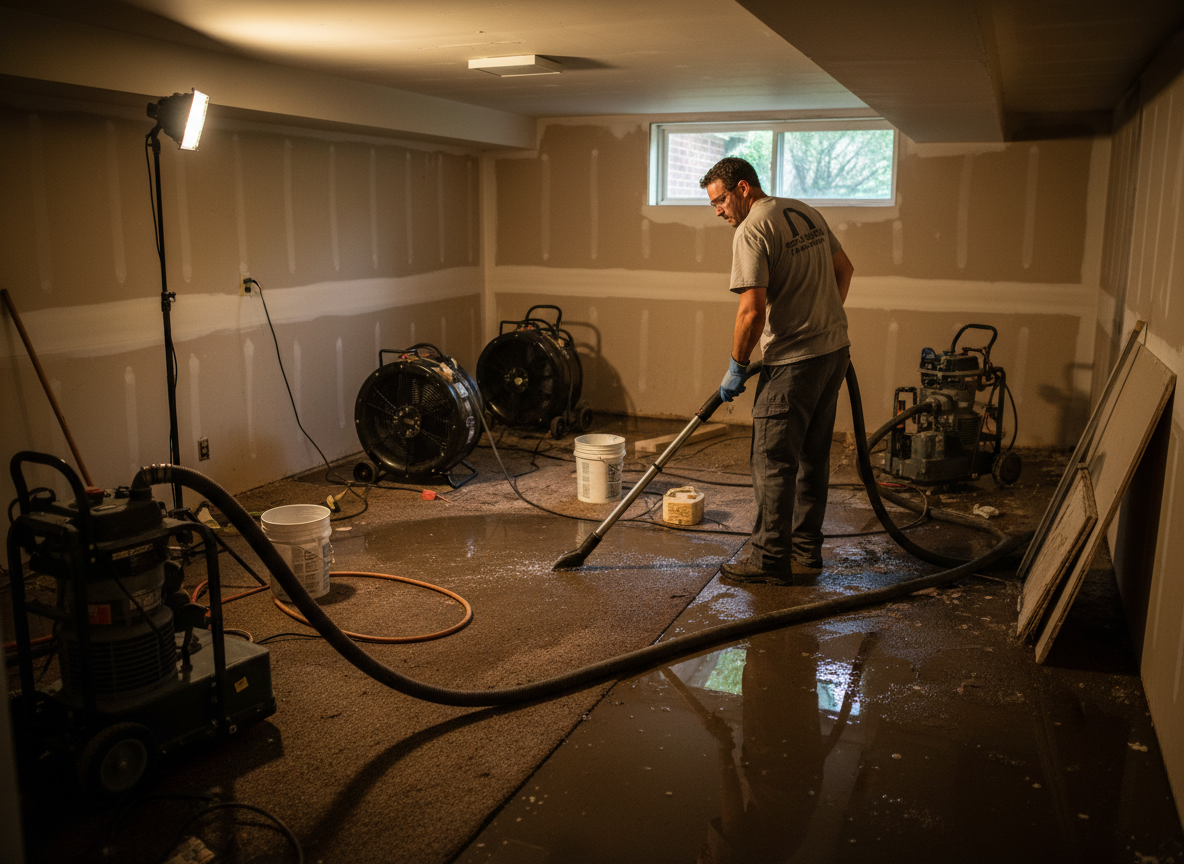
Waterloo sits in the southern stretch of St. Louis with a dense mix of pre-war brick two-flats and single-family homes built on clay-heavy soils that drain slowly. Heavy rains from the region's humid continental storms frequently overwhelm downspouts and foundation drains, sending water into basements along streets like Bates and Loughborough. Our crews based at 10550 Kahlmeyer Dr roll out from the 63132 shop Monday through Friday 8am-6pm and Saturday 9am-2pm to extract standing water and dry wall cavities before mold sets in the humid summer air.
Winter freezes followed by sudden thaws crack aging mortar joints and let ice-melt seep behind siding on blocks near the river bluffs. We see the same pattern every year in Waterloo: roof leaks at valleys on these older homes turn into ceiling stains once snow load melts. Technicians map moisture with meters, remove saturated insulation, and set drying equipment sized for the tight floor plans common here so residents can stay in place while work continues.
Access to many Waterloo properties means navigating narrow alleys and shared driveways, so we stage equipment on the street and carry gear by hand to avoid blocking neighbors. The same severe storm cells that hit Forest Park Southeast often track straight over Waterloo, dumping inches in minutes and overwhelming the combined sewer system.
Around 45. Waterloo
We regularly work near:
- 📍Carondelet Park
- 📍Bates Street
- 📍Loughborough Avenue
- 📍Wilhelm Park
Water Damage Restoration in 45. Waterloo — Local Notes
- •Clay soils and flat lots around Bates and Loughborough trap water against foundations, requiring deeper excavation for proper French drain installs than in sandier northern neighborhoods.
- •Pre-1920 brick homes dominate the stock here; we routinely chase hidden moisture in plaster-and-lath walls that standard infrared scans miss without probe holes.
- •Alley access limits large equipment, so we use portable extractors and smaller dehumidifiers that fit through standard basement doors common on these blocks.
- •Combined sewers back up fastest during the spring and fall storm peaks, pushing contaminated water into finished lower levels more often than in separate-system suburbs like Webster Groves.